
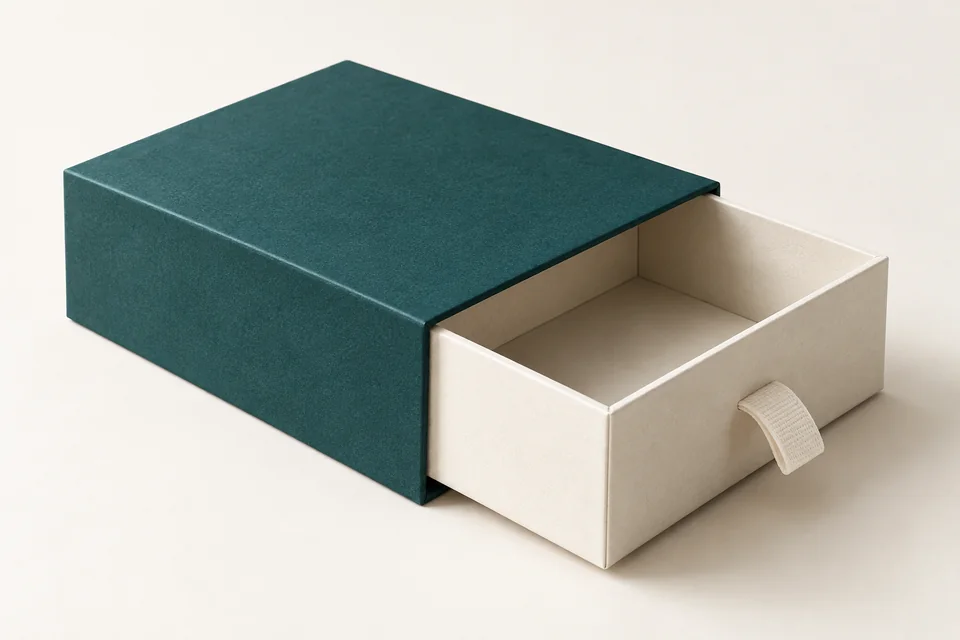
The drawer box includes an outer shell and a pull-out tray to retrieve products. A tray that is too tight can easily get stuck, if it is too loose it can slip when held. Fit should be checked on a finished sample with enough stock inside.
Measure according to product and insert layer
Measure the product along with the lining and accessories to determine the tray cavity. The drawing needs to distinguish inside and outside dimensions and clearly state the allowable deviation, often called tolerance. These parameters must be agreed upon by both parties.
Check the slippage after finishing
Paper backing, coatings and seams can all affect friction. After the blank sample, test the finished sample in the table-top position and in the customer's usual holding position. Observe whether the tray slides evenly or gets stuck at one point.
| Check point | Question |
|---|---|
| Outer shell | Are there bulges, warping or seams blocking the tray? |
| Tray | Is it square, medium and holds the goods? |
| Pull handle | Is it easy to grip, durable and in the right position? |
Design holding points as needed
With heavy or fragile items, consider details to hold the tray or limit the pull space when necessary. Do not rely solely on friction to avoid slipping. If delivering far away, consider adding a layer of shipping packaging.
A good slide-out tray when empty can be scraped off when containing a heavy cosmetic set. Therefore, the final model needs to have all the expected bottles, boxes and liners.
Is there a standard gap for every box?
There is no common gap for all drawer boxes. Size, material, squareness and backing all influence the result. Finalize with drawings and satisfactory samples.
Send SquareBag the desired package and opening method to exchange the suitable drawer box model.
Explore Paper box solutions or Exchange specifications with SquareBag.
See Paper Box group